Understanding Peptide Purity Testing
Acs Peptide Screening Laboratories Melanotan II Third-party Peptide Analysis
The dissolved peptide sample is infused into a stream of fluid solvent (the mobile stage) that streams through a tube loaded with tiny fragments (the fixed phase). Various particles "stick" to those bits with different strengths, so they travel with the column at various speeds. Refined differences in basic material purity and structure can lead to disparities in the task of the final product.Understanding Peptide Pureness Testing
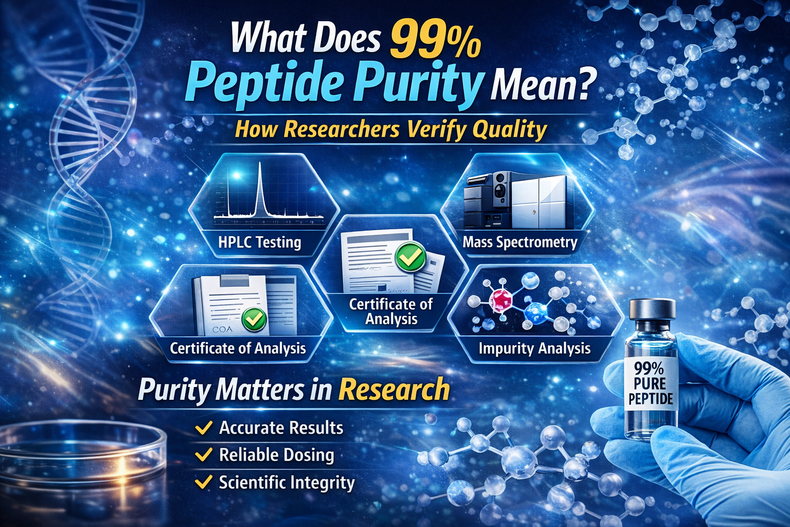
- This is the grade where the boost most greatly, due to the fact that attaining that last 1-- 3% of purity needs disposing of a considerable fraction of the synthesized material.
- For instance, abbreviated peptides or chemically customized side-products could bind to targets or create adverse effects that confuse your results.
- All products are cost study, lab, or analytical functions only, and are not for human use.
- Either can be acceptable, but third-party testing is the gold standard for research-grade products.
- Extremely few commercial research peptide vendors provide MS/MS information on routine COAs-- it is commonly scheduled for pharmaceutical-grade materials and advanced study settings.
This level of thorough evaluation makes sure the peptide's accuracy-- indicating the series and purity are exactly as labeled-- which is vital for experimental reproducibility. By confirming composition through several confirmed techniques, laboratory recognition assurances that researchers receive a high-purity peptide that will certainly execute as anticipated in the laboratory. Lab recognition of peptides is not just a scientific finest method-- it's commonly a regulative need when peptides are used in restorative growth or clinical research study.
While peptide pureness isn't the only variable, making use of badly characterized reagents is a recognized contributor to irreproducible results. For a 10-residue peptide with 99.5% combining efficiency, you would certainly expect concerning 95% of the final product to be the unabridged series before filtration. For a 30-residue peptide at the same efficiency, that drops to roughly 86%. This is why much longer peptides are more difficult to generate at high purity and usually set you back even more. Pureness is the percent of books in the shipment that have every page published properly, in the ideal order, without missing phases and no added pages stuffed in. A 95% purity means that out of every 100 "publications" in your set, 95 are perfect copies and 5 have some kind of mistake.Peptides Lab Uk
Selecting the ideal external laboratory for peptide screening involves evaluating a number of aspects. A relied on laboratory should have verifiable experience in peptide chemistry analysis-- for example, PhD-level chemists or biochemists on staff who recognize peptides' synthesis and deterioration pathways. Accreditation by appropriate bodies (such as ISO/IEC or certification for GLP/GMP compliance) is a strong sign of top quality.In basic terms, a peptide provided as 95% pure is composed mainly of the target peptide (95%), with the continuing to be ~ 5% composed of pollutants. These impurities can include points like shortened or trimmed sequences, removal variants, oxidized residues, or other minor side-products from the synthesis process. Peptides are commonly used in the medical aesthetic appeals, cosmetics, and biomedical fields because of their distinct biological task and broad application capacity. However, the top quality of peptide items straight influences their efficiency and safety, making exact top quality screening services critical.